Tuesday, July 27, 2010

Eli Comes to Town

With the rain suspended Derby (over 3 inches fell on early Sat. morning) completed on a beautiful Sunday we are now in the home stretch of making final course preparations for the Western Amateur Championship.
Before I go any further though, I want to congratulate Derby Champions, Jim Connors IV and Ken Coquillette. They shot a fabulous 17 under par on a course that, although rain softened greens were slower than usual for the Derby, had extra challenging hole locations and, rough that was plenty longer and thicker than usual! Indeed quite a score!  I'll blog a bit more about the Derby, prior course preparations, the 3" rain and our work to get the course playable to complete the Derby, and final course preparations for the Western, in a soon to be posted later blog. For now though, I want to tell you about our gazebo work now in progress.

Five years ago, after a rain shelter gazebo was destroyed by vandals, we searched for a company that could build a structure similar to the one that we had at the #12 hole pond on #3 side. Our search ended in the company Rocky Knolls Gazebos, from Rexford, Montana (Northwest corner of Montana about two miles from Canada) owned by Eli Beechy and a few family members. Eli and family are Amish and are incredible craftsman, as hardworking as you get, and just delightful folks, and at that time Eli fabricated the gazebo in Montana, had it shipped here to the club, and the two of us constructed it in the fall of 2005. We were fortunate in that they normally travel, to erect these gazebos, only in the states of Montana, Oregon, Idaho, and Washington, but they have family in Illinois and also Michigan and we were able to persuade him to stop by here and put up a gazebo for us during a planned trip visit to family. So at that time, Eli, his wife Irene, and their two sons, Nathan and Samuel traveled here by train, I picked them up at Union Station and they stayed one night at a nearby hotel. Eli and I erected the gazebo at #7 tee on a Saturday and finished it up early Sunday morning.
 The original Rain Shelter Gazebo constructed in 2005 by Eli and Me
 
 Disfigured Willow and deteriorating Gazebo before removal

Gazebo at #5 Tee prior to removal

Fast forward five years... The rain shelter gazebo at #12 pond was rapidly deteriorating and one of our other rain shelters was also in pretty bad shape. It was certainly time for them to be replaced. I contacted Eli and asked about having two more built (I was thinking he could send kits and I would construct myself) and he said and then, to my delight, asked if I would like for him to put them up as he was planning another visit to family nearby around the first week of August. The first week of August is the Western Am. and that wouldn't work for us but with a little pleading he graciously agreed to shift his plans one week so the timing would work out and the new rain shelter gazebos would be in place before the tournament. Perhaps it was because we established a relationship five years earlier, or because I did my best to accommodate Eli and family five years ago, or because ultimately we decided to have a third gazebo made, but whatever it was Eli happily adjusted his travel plans.


So, in the previous post I showed our preliminary work with removing portions of the old gazebos (and still keeping the roofs in place should they be needed during the Derby) digging footings (8 per) for piers at each location, laying out the exact pier locations and pouring concrete. With this work complete last Monday - Wednesday the concrete would be cured before Eli arrived. Yesterday the truck arrived with the all the gazebo pieces and later in the day Eli and family arrived. They drove this time (they themselves can't drive but they hired a driver, Brent, whom also assits with construction) but this trip there are a few more family members. In addition to Nathan and Samuel, they have a few more brothers and sisters, including Ruth, Paul, James, Martha, and the youngest (7 months old) is Joseph. Large families are common among the Amish as Eli has 14 brothers and sisters and Irene has 13! Eli and Irene are certainly making good progress on building their family.

Instead of staying at a hotel Eli asked if I would be willing to let them pitch a tent and stay here near the Grounds Operation Center and so without this being a problem at all, we have some visitors on site for the next couple days. Their compound is in a comfortable location on the lawn area in front of the Grounds Staff  Bunkhouse. As of this morning at 9:30, Eli, Brent, Nathan (the oldest at 11 years) and Samuel, already have one gazebo nearly complete!

Here are a few photos of all that is going on at the moment:
 Hand unloading Gazebo sections bright and early Monday morn.

Lots of materials, Lodge-pole Pine, bark stripped by hand

Eli and boys loading first Gazebo

 Some of Beechy and Cross family enjoying shade on #14 while course closed (little guy in foreground is my grandson Clark Joseph)

 Most of Beechy family awaiting dinner. Brent grilling, Eli supervising, Irene tending to children
(Amish do not take pictures or pose for photographs but Eli and Irene do not mind me taking pictures)
The youngest of the Beechy family, Joseph. ( Posing pretty well here!)
Future Gazebo builder I'm sure!

Making fast progress. Gazebo between #15 Tee /#16 Green

There is a lot of work still to do but with extra help this time around they'll be done in no time. I'll post more later on the Gazebo construction progress and much more.


Thursday, July 22, 2010

Tournament Time is Here

It's been way too long since I've posted but it surely hasn't been because I haven't had anything to post about. To the contrary! We've had so many things going on that I just haven't had time. But on Skokie Derby Eve., and the Western Amateur Championship about a week later, it's a great time to update you on what we've been up to for the past several weeks.
I mentioned in my last post that it hasn't been just the past several weeks that we've been getting ready for the Western, but in fact the last several months. Most recently though, we've made the final push to have the course in as fine a condition, both from a playability standpoint as well as an aesthetic standpoint.
Over the past several weeks, which have been especially challenging for turf survival with high heat and humidity at times (leading to high disease activity), and high heat, drought, and wind conditions at other times (leading to moisture stressed turf ), we've had our hands full just trying to keep turf healthy and alive much less carrying out several special projects. With a lot of hard work and many long days (definitely a sleep deprived staff), I think we've managed to do both fairly well.
I'll write more about the difficult weather year we're experiencing, the impact it's had on turf conditons, and reference or link you to some other articles regarding this, but for now the following items have been part of our preparations for both the Derby and the Western Am. It's a photo recap...hope it gives you a little insight into our world.
Asst. Superintendent Jacob applying nutrients and plant protectants
(a frequent activity these past couple months during these challenging environmental conditions)
Miguel & Javier checking sand depths and smoothing all bunkers

Robbie painting rails, posts, and wire of fence at #13 new Champ. Tee area
(planting of native grasses and vines to more thoroughly mask has also been completed)

Gus completing a drainage repair project in area between holes #1 and #10, an area which will be heavily trafficked during Western Am. 

Fairway rolling on Derby eve to provide smoother, firmer surfaces to aid ball roll.

Careful though - don't let that ball roll to far off the fairway. 
Here Freddy is "topping it off" - at 4 inches!

Some other tall rough you'll want to avoid! Here Nestor is finishing removal of seedling and other weeds. He and others have spent considerable time combing all tall rough areas for unwanted plants.

Otto "fluffs" same rough area after cleaning small branches and leaf debris.

With new gazebo being installed soon, it was time for this declining willow to go. 
We didn't want it falling on new gazebo - or on a player!

Rafa and Nestor pause from clean-up activities. Trunk measured nearly 5 feet in diameter.

Miguel, Javier V., and Perez remove center supports so that footings can be dug while still keeping roof in tact if needed for shelter during Derby

Drilling 1 of 24 holes, 12" in diameter, approx 42" deep. This was a day and a half job for 4 of us. Compacted clay with a few rocks and roots to go through (and 90 degree temps) made this a really delightful task!

Another 3 days were spent laying out exact positioning for concrete footings (piers)... 

and then pouring took place.  Several of the crew were involved in this project with Steve as my main assistant. All piers are now in place and curing. Old structures will be removed Sunday after Derby and new structures will be erected next Monday, Tuesday & Wednesday.
Eli Beechy, the Amish-man from Montana will be coming in town. More later on this....

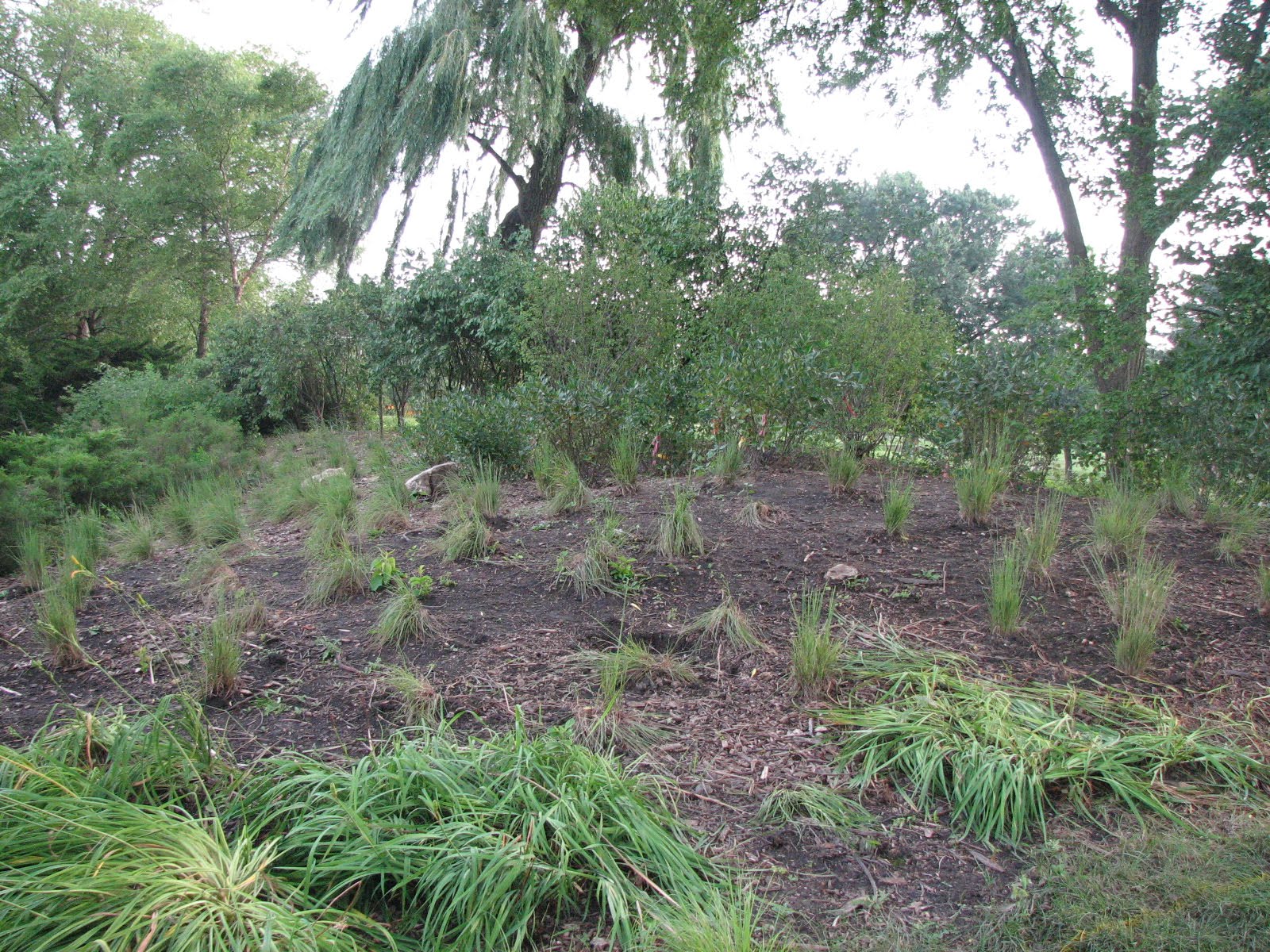
  Another project (following removal of several disfigured and diseased spruce trees) was new landscape plantings at #9 pond.

New plants include Serviceberry, Chokeberry, Little Blue-stem, Indiangrass, and False Indigo

Cirilo removes a dried divot and fills with...

a green dyed sand, peat, and seed mixture

 
Miguel does a little "Aquatic Gardening"...thins some of the water lillies

& after a Derby eve mowing, to help gain some putting green speed...
(we'll do this a couple times in the morning too!)

The course is... Ready for the 60th Run for the Roses!

Best of Luck to you all!

Thursday, June 24, 2010

Ventilating the Greens

With the frequent and above normal amounts of rain over the past seven weeks, saturated soil conditions are present throughout the course. And now, with very warm temperatures upon us, the combination can rapidly lead to turf root loss and diminished quality. In spite of numerous core aeration sessions over the years and nearly 5" of sand topdressing (from 20 years of work) providing a porous surface rootzone, with the excessive amount of rain we've had recently and internal drainage lines on only a few of our newer greens, we recently started a process of Greens Ventilation.This is really just an aerification process but without removing any material and using a special tine called a cross tine. No it's not a special tine that I came up with, I wish I had, it's a special tine that is available from a tine manufacturing company shaped like two intersecting double sided knives. We use our Toro Procore aerator and adjust the depth to approx. 3 inches, and the spacing to approx. 1 1/2" on center.
Rafa beginning Ventilation process

As the tines are inserted, a cross like cut is created and these cuts result in much more area affected and open to air movement into (providing oxygen) and gases out of, the rootzone soil. A great feature of this tine is that while it affects a nice amount of underground area, the surface is minimally disrupted. 
Green surface after "cross tine" ventilating, prior to rolling

Javier rolling 

After rolling the green following ventilating, ball roll is minimally, if at all, impacted, yet valuable benefits of oxygenation (aiding root system support) and rootzone soil drying (aiding surface firmness, and ball roll) are gained. This procedure may be repeated in the coming weeks if our current weather pattern of frequent rainfall continues.
 Putting surface after rolling...surface nearly closed but ventilation channels beneath remain

As soil temperatures rise in the summer months, root growth slows and even ceases. And of course, without roots, plants weaken and ultimately die. Moist and/or saturated rootzone soils warm and retain heat more than drier rootzone soils and so anything we can do to dry and cool the rootzone, and retain roots, is critically important. Ventilation certainly helps in this regard!


Tuesday, June 22, 2010

Another Stormy Kiltie Days

Last year it was a flood (we played only 13 holes on the second day), about 10 years ago it was a microburst felling 42 trees, there's been other years with strong storms and downed trees, there's been some years with very high temperatures, and this year Kiltie Days once again had quite unsettled weather. Fortunately we didn't get the flooding rains of last year (we had just .75 inches) and it wasn't until most of the days matches were complete, but we did have gale force winds (over 65 mph) and the aftermath left 3 trees, the tops of 2 more, and a huge mess of smaller branches and leaves littering the course. And, there's still many broken branches up in tree canopies, and probably more that we haven't seen yet (but will when they begin to wilt and turn off colored), that will all need to be pruned in the coming days.
 
 The subject of a long Friday night! (fore and aft the sand piles)

 
One of at least 5 causalities of the 65 mph winds

From the time the first storm on Friday passed (there was another overnight) until well into the dark hours of the night, our grounds staff sawed, hauled, blew, and raked the debris and had the course fairly well cleared. The overnight storm then brought down a bit more debris and so bright and early (well, not so bright...but definitely early!) Saturday morning, more blowing, raking, and mulching brought the course to a tidy condition once again. It was certainly a long week preparing for the event with multiple mowing and many other maintenance tasks before and during the practice round and throughout the event, and then addressing the wake of the storm, but I'm happy that this year's Kiltie Days proceeded with only minor disruption and that the rain totals were relatively low.  

It's been a different story over the past two months as the data below shows!

Over 5.5 inches more rain than normal for the past month and a half!

It's rained 15 of the last 22 days, and we've had 3 inches more than normal in May and 2.5 inches more than normal so far in June. Unfortunately more is expected tonight. I'm thinking this 5.5 inches extra rainfall to date, might just have something to do with the rough (and all areas) being very lush, and the fairway and green surfaces being softer and slower than usual! A little drought would be just fine about now!

Wednesday, June 16, 2010

Seven Weeks and Counting

It's been over two weeks since I last posted (which is indeed much longer than I like) but it seems like it's been so much longer with everything in full swing and many course activities in progress. Time sure flies and before we know it, Kiltie Days will pass, then it will be the 4th of July, then the Derby, and very shortly thereafter, The 108th Western Amateur Championship. A member asked me the other day "When will you start preparation's for the Western Am."? I though for a second and replied, "Well, actually we started preparing about eight months ago!"
At that time, October 09', we were modifying (rebuilding and adding) the fairway bunker complex on #18, expanding a few fairway areas to better incorporate bunkers into fairway contours, extending #17 tee, installing drainage in a few poorly drained fairway and rough areas, building the base for the new cart path (brick edge and crushed brick) at #12 Green / #13 Tee, and much more.
I told the member "eight months ago" but now that I've thought more about it, I probably could have said, "two years ago"!. It was then that we started the installation of the new irrigation system which, if it ever does get dry this year, will give us the ability to water only where needed, or where desired. For example, should the rough start to go dormant we can keep it well irrigated without adding any extra water to the fairways. We could also water the slopes and surrounds of the greens, without putting any water on the putting surfaces. Our goal as we approach the Western, should we get cooperation with the weather, would be to have fast and firm fairways, approaches, and greens and "healthy and challenging" roughs and green surrounds. Our new irrigation system features the ability to water each of these mentioned areas independent of the others. At this point I'm hoping that we get the chance to use it as opposed to the frequent rainfall we've experienced lately! This high moisture and high humidity recently has caused saturated and soft ground conditions and dense, lush and slow turf conditions.  I'm really looking forward to a break from this rain forest-like weather very soon!

Our projects this spring are progressing nicely and have included:
  • Repair of winter damaged fairway areas(several seedings and finally sodding using our "home-grown" sod and "harvested" sod from shifting the beginning of #7 fairway) is now very near completion. This damage was the worst I've seen in my 20 years at the club and it's repair has required nearly daily efforts for the past six weeks! It's nice to be about finished
  • Extension of #10 Tee and landscaping behind tee complete.
  • Grassing of buckthorn cleared area adjacent to #9 tees is complete and seedlings are emerging. We'll soon add some established native plants, Indian grass and Little Blue-stem grasses, to supplement seeded plants.
  • Cart Path at #12 Green/ #13 Tee now complete.
  •  
Otto and Javier near completion of winter damaged fairway repair - they've been at it for nearly six weeks now!
    A sample of winter damaged fairway turf being removed

    Tee #10 sod work - now complete, including planting ornamental grasses behind tee


    Tee #17 - extension now complete

     New cart path complete at #12 Green / #13 Tee

    Fine Fescue grass seedling emergence at #9 Tee

    Plenty to do in next few weeks:
    • Sod any bare spots such as cart traffic areas and tree stump holes.
    • Renovate cart path (add brick edge, soil separator fabric, and crushed brick) along side #9 tee.
    • Remove deteriorated asphalt on pathway from #11 tee  to #2 green, and replace with crushed brick.
    • Erect three new gazebos to replace deteriorated ones at #5, #12 and  at #15 tee / #16 green.
    • Replace some of overgrown shrubs at Half Way House.
    • Repair and sealcoat main parking lot and lower parking areas (by lower tennis courts) and perhaps paths adjacent to putting green, #1 tee, #10 tee, and near range tee.
    • Water-jet several tile lines exhibiting slower drainage.
    • Continue to attempt to "tame" the rough, and \conduct all routine daily tasks such as hole location changing, tee servicing, mowing (greens, tees, approaches, fairways, intermediate rough), bunker raking, range tee and chipping area overseeding and set-up, plant protectant applications as needed, and much, much more.
    I'll try to post more frequently on these projects, and other activities, as they progress.

     A few of the eight new residents at #9 pond -  Mallard Ducklings!

    Friday, May 28, 2010

    A Word about our Rough

    I've been asked this question a number of times recently, "When are you gonna cut the Rough?"  I understand the reason for the question, it is quite challenging at present, and I want to mention a few things regarding this area of the course.
    First of all a couple facts:
    • We've had environmental conditions recently that are highly conducive to rapid turf growth; plentiful moisture a couple weeks ago (remember the 3.5 inches of rain?) followed by our recent warm temperatures. The combination results in rapid turf growth everywhere.
    •  During this period of very active growth, the rough is being mowed every day. We mow it all and then immediately start over again. It takes a few days to mow the entire rough, depending on play activity.
    • It is being mowed at the same height as always.  No higher, no lower. Why don't we mow it lower? There are a number of reasons mowing at our current height is best such as: improved wear tolerance; less susceptibility to disease, weed, and insect pests; and our general course playability intent (it's supposed to be challenging); but perhaps most important is that the root depth and density (and overall health) is greater in higher mowed turf compared to shorter mowed turf. These benefits provide a greater likelihood of the rough being healthier and more tolerant of the stresses of heat and drought and/or humidity that may occur later in the summer.
    • We are not already "Growing the rough for the Western Am." It is true that we did fertilizer the rough last fall to improve the density, promote lateral spread or "fill-in" in thin areas, reduce weed encroachment (dense turf resists growth of crabgrass and may other weeds) and insure general plant health, but this is nothing new. We fertilize many areas of the rough every fall and other parts of the rough at least every couple years. We will be growing the rough longer for the Western Am. but not until much closer to the event.  More information will be coming in a future blog regarding this and other tournament preparation issues.
    • It will soon slow it's growth rate as temperatures warm, moisture becomes less frequent (generally this happens in summer) and traffic (carts and equipment) wear it down somewhat.
    Hopefully we don't have too much heat, or drought, or wear, because we do want to have healthy rough, but it is likely it will thin out as summer progresses.

    One additional fact that is occurring right now and one that I feel is perhaps the greatest reason for the rough being quite tough to play out of, is the heavy seeding now in progress. Wherever one looks there is massive seed production in progress on many plants including trees and grasses alike.  Cottonwood seeds, Maple and Elm samaras (commonly called whirlybirds or helicopters), and other tree seeds are littering the course daily, making putting, mowing, (even breathing...in the case of cottonwood seeds) difficult. At the same time all the grasses such as poa annua (on the greens, tees, fairways) and the bluegrass, ryegrass, and fescue (in the rough) is heavily seeding making mowing and shot-making difficult as well. It is the very tough, bristly like, fibrous seed stalk that is making the rough very difficult to hit out of. The following photos should help to illustrate my point.

     Plentiful seed production from many plant species in progress

    Rough prior to mowing showing numerous seedheads

    Close-up of bluegrass (rough) turf. Note erect seed stalks in center. These are much "tougher", and more fibrous than wider grass blades to sides of center stalks.  Tough seed stalks makes getting a club through turf canopy much more difficult.

     An attractive out-of-play area adjacent to #13 Championship Tee. 
    Orchard Grass seedheads in foreground and Fescue in background. 

    As I mentioned earlier, the current lush growth will very likely moderate as temperatures warm and moisture diminishes. This will thin out the turf stand in the rough making for easier play than at the present time. In addition the seeding phase will soon end (couple of weeks) and the tough seed stalks will wither and become much less resistive to shot-making. Thanks for your patience and I do hope you find the 36 acres of short mowed fairway, which incidentally is 15-25% more than most golf courses in our area, much more often than our present very challenging, rather aggressive rough.


    Monday, May 24, 2010

    Course Etiquette #2 - Refraining from "Practicing" on Course

    It's an extremely busy time on the course and I'm anxious to blog about a number of items such as:
    • The Annual Skokie Bird Walk (recap from May 17th.)
    • A Fairway/Bunker drainage project on #13.
    • Tee Extension Project completion at tees #10 & #17.
    • Re-establishing our Nursery Green & Fairway between holes #7 & #8. (Fourth time now - we've done a lot of expansion over the last several years!)
    • Ongoing winter injury repair (sodding many areas now)
    • New Staff : Assistants Jacob & Ryan
    • & several course etiquette topics.
    I'll eventually get to all of these items (I hope to anyway!) but after seeing what I saw this morning, while traveling the course, I felt compelled (nice way of saying I was angry or perhaps very disappointed) to write this 2nd Course Etiquette.  It's really quite simple. The course should not be used as a substitute for the driving range, or stated another way, several balls should not be dropped and hit from the same location on the course creating several divots in one area. The photo below is what I saw first thing this morning.
      Please Do Not "Practice" on the Course!

    Imagine if every member dropped 5 balls, took 5 divots, and didn't bother replacing them! The disappointing fact is that this seems to be happening more often. It's not the same person as I've seen at least three different members.
    If you should happen to see this "practicing" taking place, please ask the player to stop or let me know. It's only proper course etiquette!
    ***If you are a first time visitor to this blog and would like to view our Welcome Message, which includes the 2008 Year in Review slide show, click HERE.