Thursday, August 30, 2012

Summer's Intensity Yields

To begin, Yes this is long overdue! I suppose I could say it's been one of those very difficult summers where I had very little time to spend on my computer, and I would be entirely accurate. In fact I could say that I'm quite sure I spent less time in my office than in any summer ever in the past, and the various piles of magazines and product info. pamphlets stacked throughout my office, that I've yet to read, are a daily reminder! It was a summer where it was much easier to communicate using Twitter, where I could send a picture and a brief note daily or more often. Over 400 times to be exact and most related to course activities. So those that follow me or check in here in the Twitter section have kept up to date with course happenings this summer.

It was for sure a record setting year. One of the earliest starts to the season that I can remember, and of course we all know most of the story with 43 days of temperatures over 90 degrees (and counting) and a half dozen of which were over 100! This is certainly abnormal and well above the desirable range of our cool season turf species of creeping bentgrass, poa annua, bluegrass, fescue, and ryegrass. And, if high temperature stress wasn't enough, a serious lack of rainfall added additional stress and required nearly constant monitoring and frequent (much more so than I've experienced in the past) syringing, to cool the turf and prevent permanent wilt and turf loss. Too many times I watched turf go from green, well hydrated, in the humid mornings, to purple, and early stages of wilt, in the dry, windy afternoons. Also, Murphy's Law was in effect as it seemed to happen even more often on Saturday's and Sunday's when the course was full of players making my syringing processes even more challenging and mentally stressful! We do try very hard, all the time, to provide firm play conditions, and regulating irrigation is common in this effort. As such, having to rapidly move about the course, syringing to prevent wilt and turf loss, is certainly not something new. This year, however, it seemed like we were chasing wilt nearly every weekend!

It was a nerve-racking year indeed but as we headed into the second week of August relief came in the form of both rain and cooler temperatures. And, although we've had a few more hot, humid days since earlier in Aug., the intensity is shorter with waning day length, lower overnight temperatures, and thus far occasional rainfall. We're now entering the optimum time for restoring turf health and density though a variety of cultural practices such as fertilization, aeration, topdressing, seeding, or sodding. We've already begun many of these practices and after Labor Day more such activities will intensify. Fortunately, we survived the summer quite well but some areas do need some expanded work, mostly rough areas, and right now we are beginning to address these areas (seeding / sodding) and will continue into the fall. I'll try to blog more often as we perform these various tasks and projects such as fairway expansion, green surround sod replacement where needed, test area bentgrass control and overseeding in rough areas, and likely a few other projects.   

Some Summer Recap photos and comments follow:
Saw this about 6 times this summer. 6 TOO MANY!

 The summer began with a little pond wall repair project at #12 tee! Old tiebacks gave way and wall collapsed into pond 

  After excavation of soil and lots of unexpected concrete blocks old steel was righted and cut off at water level


New steel channels being locked together and vibrated into soil


 Installing new and improved tiebacks

 Finished product. Today area grassed but heavy weed encroachment may require additional grassing work this fall

 While we were at it with excavator on site we pulled tilted outcrop stone from west side, added new support beams and gravel, then reset level

 Finished product on west side. Today fully grassed with quality fine fescue.

As work was undertaken on the pond wall repair, 4 forward tees were constructed and opened in early June

 
Several cart paths were renovated. Old fabric and loose brick chips was removed and replaced with new crushed red granite.

 
New path to No. 3 Forward Tee

 
Renovated path at Half Way House. New material stays in place much better and is less dusty than former crushed brick material.

 
New routing of path at #18 Tee, now runs through tall grass instead of directly in front of tee. No traffic in front of tee now eliminates worn unsightly area.

 
Finished product with repositioned tall rough and re-routed path

Right about this time, the 4th of July (and the 5th), temperatures exceed 100 degrees and from that time forward temperatures remained above normal for about six weeks. Moisture deficit was firmly in place by this time too, actually since much earlier in spring. 


Saw this sign in a business and thought, regarding the weather challenges this year, 'Isn't this the Truth'!
There was lots of it every morning!

 
This was a common sight this year and thankfully we have an outstanding irrigation system that allows us to keep conditions as dry and firm as possible, for playability sake, and yet provide "rescue" syringing and watering, in a rapid manner, to prevent serious turf damage and loss.

 
When we keep it dry, and the humidity suddenly drops, turf can purple showing signs of wilt.

 
If we don't get water on it quickly (such as on a Sat. afternoon when the course if full of players and we're desperately trying to syringe and cool off all fairways but we don't get to all areas in time), at the early wilt stage, cart traffic will crush plant cells, causing destruction and turf loss. Fortunately this was the only area this happened, at beginning of fairway on #17.

 
We battled plenty of disease this year as well, Summer Patch, Brown Patch, Dollar Spot, Fairy Ring and others...we saw them all at one point or another.

Fortunately, Pythium, one of the most rapid and destructive turf diseases (common in hot, wet, conditions) was kept well controlled through plant protectants (dry weather helped too) but still found it's way onto the range tee, an area that is watered frequently to germinate seed planted each night.


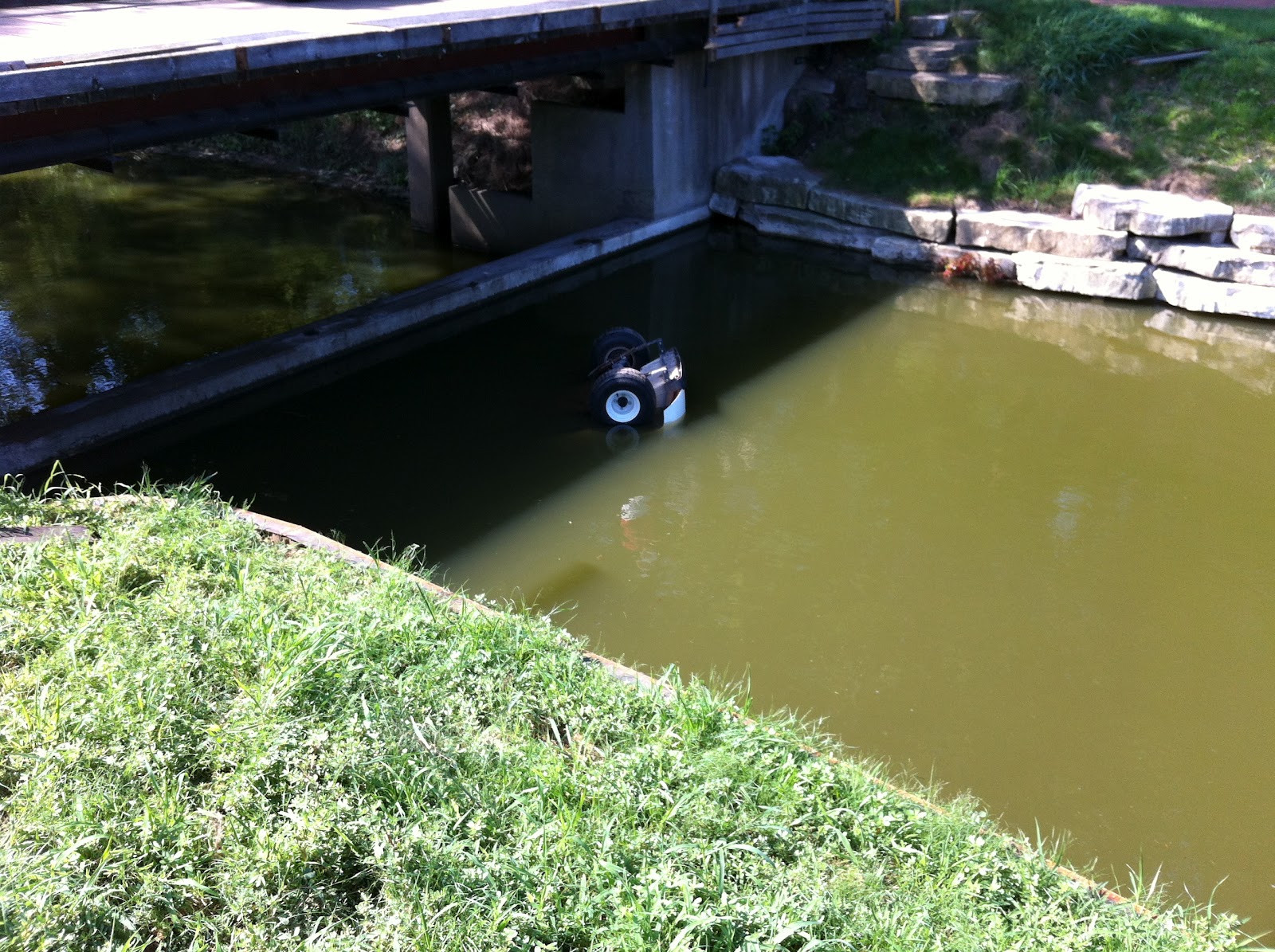
Speaking of wet, we did have a few wet moments this year...climbing into the water to attach lines to remove a cart that was driven into the pond at #12...


and a Jeep that found it's way into the ditch at #13 tee.

 
 Both vehicles...


Successfully extracted and both drivers, fortunately, uninjured...but likely to drive a bit safer in the future!
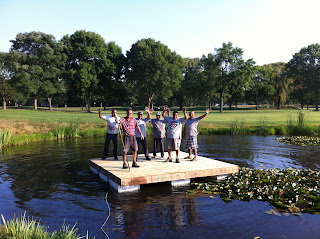
 We though we might have to employ our SCC Grounds Crew constructed SCC 'Kon Tiki' for above extractions, but it was ultimately used only for it's intended purpose, the Hampton's Party.

Jazz Band getting ready for their float trip.

Before crowd showed the ducks enjoyed a little evening music.

 The stress...and response (more hand watering) continued through approx. Aug. 9-10 when we received some quality rainfall (slow, steady) and temperatures began to fall to more reasonable levels.

 
With the summers intensity now behind us we're focusing on repairing a few areas...fortunately only a few! Through aeration, spiking, seeding, and /or sod patching where necessary.

A nice seed germination 'catch' on a worn, thin spot in the green expansion area on #13.

As I mentioned earlier, we are now in the period of repair, recovery, maintenance, and improvement on many turf areas through aeration, seeding, topdressing, core planting, sodding, and more. Essentially, it's planting time! I hope to blog a bit more frequently now that I have a bit more time to spend in front of the computer but I'd still much rather be out on the course tweeting tasks and improvement progress on a daily basis! Follow me on Twitter @scc1897 or check back here on the blog often and view my tweets in the Twitter section. Happy Labor Day to All! 


Thursday, May 31, 2012

New Bunker Rake Placement Positioning

Where to place bunker rakes has been a topic of discussion for many years. Placement in or out of the sand is typically the debated issue. At USGA and PGA tournament events placement is generally outside the sand, and in some cases the rakes are completely removed as ample volunteers rake after players as needed. On the other hand, at many typical country clubs or local courses, rakes are often placed outside the bunkers as it speeds maintenance by the worker not having to move every one every time mowing is conducted. Also, inside the bunker they are not vulnerable to being run over and broken by carts. This can lead to a significant cost each year as we use a traditional handcrafted wooden rake and the cost of replacement for the careless cart operator is over $60 each!

Committees, Player, and Course Superintendents have varying opinions about rake placement, and for what it's worth, mine is that rakes should be placed inside the sand, because if my ball were to hit it and it result in a poor lie, well, my ball was likely destined for the hazard anyway and whatever the outcome is the result of my poor shot. Conversely, if the rakes are outside the bunker and my ball hits it and it ricochets into the hazard, well, then perhaps I might feel that it unfairly caused my ensuing bunker shot. You may have a differing opinion but I will say that over the years (that's 22 now) I've had only an occasional mention of rake placement and so apparently the Grounds & Greens Committee's decision long ago to place them inside the bunker has generally been acceptable.

Having stated all this, what I really want to mention in this blog is how we are changing the placement of the rakes inside the bunker. Simply stated, instead of placing the rake parallel to the bunker edge, the Grounds & Greens Staff will now place them perpendicular as we prepare bunkers every morning. We are asking that you place them in the same manner and please feel free to remind your caddies and fellow members to do the same.

 Former rake location was to place rakes parallel to bunker edge.

With rake placed as above there perhaps is a greater chance of a ball coming to rest at the rake head and this could result in a more difficult lie near the bunker edge, than otherwise might occur.

New rake location is still completely inside sand, on outside or leading edge of bunker  (with handle about 6-8 inches inside edge) Perpendicular to edge as shown above.

The idea in testing this new location is that perhaps it will impact final resting location of a ball that rolls up against it, more favorably, than a ball that might come to rest at the rake head with the former location. In this new location a ball may stop against it but perhaps it will be more likely to lie further toward center of bunker rather than closer to the edge.

We'll see how this works, we'll hope it is observed by all and placement will not again become haphazard, and we welcome your input. More importantly, as far as I'm concerned, is that the bunker rake is used after a shot (it's our responsibility as players), and the rake is treated with care and not thrown or driven over or stepped on which can damage or destroy it. It's embarrassing to say this but over 50 rakes were damaged last year and the majority had to be replaced. Please use care and correct anyone, players, caddies, staff, anyone, that mishandles these rakes. Thank you for your cooperation! Now go get a lesson and come out and practice so you quit hitting it in the bunker in the first place! 

Wednesday, May 30, 2012

Scouting Report compliments of CDGA & Dr. Derek Settle

Oh where has the time gone? It's mid summer right? No, it just feels that way with rather dry conditions and a few mid 90's thrown in for good measure. At least this week will cool off a nice amount and re-set the summer clock a little!
I know it's been a while since I've posted, but between building tees, working on replacing the collapsed retention wall at #12, planting all the summer annuals, trying to keep up with plant protectant applications (earlier and more frequent needs due to the early spring/summer) and dealing with the early hot and dry conditions (irrigating, hand watering), I frankly have had limited computer time! Those of you that do follow me on twitter, @scc1897, do know that although I may at times blog infrequently I do at least tweet very often, daily or more often, about many of the activities on the course. You can also see the twitter feed (to the right) on this blog as well and perhaps this is a way you might follow should you rather not follow on twitter. I will say I have had many comments from members stating that they appreciate and enjoy following tweets of course work and other course activities, nearly as soon as they occur, via their smartphones.  Want to know the very latest about what we're doing on the course?...follow me on twitter.  
I'll blog again very soon about our main project at hand, the pond retention wall, and a few other items such as; a new placement method for bunker rakes; a practicing method (desired divot pattern);and more, but for some time now I've been wanting to blog about The Scouting Report that follows:

All of us that are involved with Golf in Chicagoland, whether intrusted with the care of a golf course, as GC Manager or Superintendent, or, as a player of the game, have a valuable asset available to us. That asset is the CDGA and more specifically (for those tending to courses), the CDGA Turfgrass Program. Research, product and variety trials, education events, and on-site visits are just a few of the many benefits provided by Dr. Derek Settle, Director, and Tim Sibicky, Manager of Turf Research.
We are all indeed fortunate to have this local source of excellent information and assistance to help provide solutions to challenges we face on the course, thereby improving our ability to provide high quality playing surfaces for the great game we all love.

On a weekly basis Derek and Tim distribute a report, the Scouting Report, that is chock full of weather information, charts, current pest occurrences, research activity and much more. It's simply outstanding information that helps us plan better and ultimately provide better turf conditions.

I thought I would begin to post this report fairly often, if not weekly, to give members and others that visit this blog, a little deeper look into the world of golf turf management. Be sure to click on link to view entire report. 

May 25, 2012 Scouting Report
High Temps Hit 90s Early: Lack of Rain = Dry, Handwater Management Starts, Peter thinks Root Research, and Tim says "Fairy Ring Research Begins"

Chicago/Northern Illinois Update: Derek Settle, CDGA
Memorial Day Weekend Arrives and yet it doesn't seem quite right. So far this season has advanced early, but the poor old calendar just progresses according to numbers. To me and to others, Memorial Day came and went a month ago - this calendar is of growing things. To the uninitiated all seems well, but folks that maintain the landscape are tired - they had to start "doing" a month earlier than usual. What continues to concern us, just a little bit, is exactly just how this growing season will play out since such a spring has never been recorded. March amazed us with 80s for highs - nine consecutive days. Later, April calmed us with more normal temperatures, but a lack of rain meant we were very dry. May saw the usual zig zag of spring as Mother Nature's final cold frosty breaths were exhaled. May's final full week has arrived and already Chicago is counting her first few days above 90 degrees - usually this begins in June.

But May is not over when one more piece of awe inspiring meterological information (AIMI) hits the news, a 100 degree day forecast for Sunday, May 27th. Currently, it isn't even summer and eyebrows (mine especially) begin to look like twin mountain peaks. During summer in Chicago we know the century mark is unusual to cross at any point. For example, we saw 100+ last July, but the last time that had happened was 2005. The earliest 100+ degree day in Chicago (Midway Airport) hails back to May 31, 1934 - dust bowl years. Hang on, summer just arrived.

Click here to view the May 25, 2012 Scouting Report.
Hope you enjoy the report!

Friday, April 20, 2012

Course Happenings

After record setting warmth and very low moisture conditions through early spring, the last ten days or so have been a bit more normal. We've seen cooler temps, a few heavy frosts that set back the earlier lush green color, windy conditions, and a weekend rainfall of over 1.5 inches. All more typical than the previous 5-6 week period. With the delightful mild and dry weather early on, we made remarkable progress with course preparations and various projects and now, although we've gone from short sleeved shirts back to jackets and hats, our good progress continues.

The following photos will give you a glimpse at our current activities. I may have tweeted some of these photos already, so those of you who follow me on twitter may have seen them. Those who haven't... well, you could follow me @scc1897 and be kept up to date, on a nearly daily basis, of our on course activities.

Miguel clipping the tall grass areas - Performed each spring to help manage ultimate height yet still allowing for the attractive seedheads to develop.
 
We Sand Topdressed fairways early in mid-March with a moderate rate and have been working the past two weeks on applying our second application...much heavier this time but sand is being partially incorporated with follow up Solid Tine Aeration.

 
Partial incorporation with Solid Tine Aeration (remainder is brushed into turf). Notice no-mess with this technique compared to former method of core aeration and pulverizing (and mud mess that usually followed!) technique. We have 3 fairways to complete at which time we will have applied nearly 1000 tons of sand this spring. 
That's 43 semi truckloads or...2,000,000 lbs., or...oh...a few billion grains I suppose!

Ash Trees have been hit hard in our area by the Emerald Ash Borer. This week we removed several trees. This one had much more than borers working on it. These are channels from other common borers as well as carpenter ants. The ants colonize trees with decay.

 Here you can see the galleries created by the Emerald Ash Borer larva which feeds in a serpentine pattern, just under the bark, disrupting the water and nutrient vessels which in turn lead to deficiencies of both and ultimate dead of the tree.

 
 This is the culprit - live and in color (white), responsible for the death of many Ash trees throughout the Midwest and beyond. We have been treating for this insect for several years but perhaps the insect was already present and had already damaged the water vessels (which are the same one's needed to distribute the insecticide we used) diminishing it's effectiveness.??? 
In the end we'll probably lose most of our 200 or so ash trees remaining.

 
 Bunker Rip-Edging began this week and will take several weeks to complete. A spading fork is inserted at the original bunker edge and the tuffs of sod are "ripped" away, sand is shaked off, then edges are compacted and entire bunker raked smooth.

 A completed bunker, one of 92 we perform this procedure on, on an annual or every year and a half basis, depending on encroachment growth rate of adjacent turf. Labor intensive, slow process but hopefully only a couple more weeks to completion.

 The second of four forward tees being constructed this spring. This one on #7 and one on #3 are ready for sod installation which will be done all at same time when all are ready for sod, likely in a couple more weeks.

 Fill material and rough shaping at #13 - location of another of the four forward tees. Final shaping, drain tile installation, gravel and rootzone mix placement, slope topsoil addition all remain but goes quickly after the initial step of fill material hauling and subsurface shaping.
The fourth forward tee will be installed at hole #17.

 A new project will begin soon, this one not at our own choosing. Steel retention wall adjacent to #12 regular and middle tee began to collapse last weekend. It's probably 50 years old or thereabouts and has obviously rusted though (or the supports have) and now requires replacement and/or some other type of retaining system. 
Study is being conducted now to determine best course of action. I'll keep you posted here and on twitter @scc1897.   

That's all for now. See you on the course soon!


Saturday, March 31, 2012

March's Madness

As the NCAA's March Madness wraps up this weekend so to does a month of unusual Madness for those of us in the business of golf turf maintenance. Perhaps Mad-rush might be a more apropos term given the frenetic pace we're off to this year!
Our spring tasks started very early, much earlier than usual, with greenscover removal (which were subsequently put away until next Dec. - a first in 22 years of use that I didn't recover at some point in early spring)  followed quickly thereafter by rolling, mowing, topdressing, and much more. Greens were opened as early as I can remember and, with the weather that followed being unusually mild for March, I'm sure when the numbers are tallied the golf rounds will be of record amount. For sure a bonus for golfers this year...and for our early season course work activities!

Is this good for the course though, such an early start? Are there special issues that could result? Could this mean an abnormally warm year? Of course the final answers are yet to be known but following are a few random items I've thought about recently and then some photo's of our Mad-rush this month:

- According to Cheryl Scott (NBC Meteorologist)...March will go down as warmest ever with an ave. temperature of 54deg, beating old record 46.8deg in 1945.
-Our mild winter has certainly given us limited (if any) problems related to winter diseases, and/or ice injury. After back to back years where we did have ice damage and/or crown hydration injury, it was a nice relief coming out of winter with only a couple spots of snow mold disease. 
- Early start (and relatively dry) has allowed us to accomplish much more in last three weeks than typical. All main areas of play (greens, tees, approaches, fairways, intermediate roughs, green and tee banks) have been mowed multiple times. Many rough areas have been mowed as well. Greens have been rolled several times and we are likely to have cutting height down to peak season height much earlier than normal. Will all this earlier necessary mowing and height reduction have a negative impact on rooting depth? Shorter heights>shorter roots.  
- Greens have been topdressed twice, fairways once with second app. coming soon. Overall I think this is a big bonus as whenever we can topdress during times of low stress (mild temps) its a good thing.
- Speaking of stress, a couple weeks ago we had to re-fill and pressurize the irrigation system as a few greens were already under moisture stress! It was a bit of a mad-rush to get the system going so that we could limit the stress. Shortly after we applied a wetting agent and then a timely rain washed it in nicely. A second application has already been applied as part of our bi-monthly treatment program. Irrigating and wetting agents in March...never before have I had to do this!
-Diseases, Insects, Weeds. What's going to happen? More or less? Well for sure they are present earlier and controls are needed earlier and so as I see it, it's likely we'll need more products. Much of course, depends on weather conditions this summer. Mild conditions would generally help reduce plant protectant needs while extreme conditions will definitely increase needs. Dr. Derrick Settle, CDGA Plant Pathologist has already seen Dollar Spot, Fairy Ring, Waitea Patch, in Chicagoland, all typically not seen until later in spring. I've seen Microdochium, and Waitea, which we've since treated for, and we will soon make a preventive Fairy Ring suppression application to our greens and fairways. Last year this treatment was 2nd week in May, this year... 1st week in April! Warmer soil temps mean weed seeds will germinate earlier and we had a bit of a mad-rush getting our pre-emergence application out in our tall rough areas (used mainly to control foxtail in these areas). Broadleaved weeds are already popping out too and control will be needed sooner than usual.
-Regarding insects, perhaps we'll see more since the mild winter temperature likely killed off fewer than normal. Maybe more cutworms (that overwinter as adults) will require extra control applications but if temps remain warm it's possible that gypsy moth larva will cause less damage to oak trees. The warm weather has brought out the larva but the leaves of many oaks (their food source) have yet to emerge. It's just possible that many could starve to death before their food is present. A good deal for the oaks! Time will tell.
-Our Bird Walk is May 9th this year when we have a couple really knowledgeable birders (they can identify most by just hearing their song) join members and their guests for a bird watching hike on the course. With the warm weather will their be any migrant warblers left? Fear not, the migrate based on light (day length) not temperatures. So be sure to join us on May 9th! I've seen Bluebirds, Cardinals, Chickadees, Robins, Woodpeckers, Kingfishers, Ducks, Hawks, Herons, and more and we'll likely see them on May 9th too!
-Fortunately several crew members are back and we've been able to address most of the spring preparation work, topdressing activities (listed above) and even make progress on other items such as: tee construction (4 forward tees planned), a drainage project, repairs to drain basins, landscape bed clean-up and pruning, sprinkler head and basin edging, and more. The crew certainly doesn't mind the early start to the season (except Equip. Tech Mike who would have liked a couple more weeks before needing most equipment!) but their are financial labor implications (budget could be exceeded) and, equally concerning, I'll need to be mindful of staff "burn-out" with the mad-rush pace we've begun this golf season with. Perhaps we'll balance out a little in April but I surely hope it does not come in the form of excess rainfall!

So these are a few of the things I've been thinking about lately, aside from wondering whom the Chicago Blackhawks might begin their playoff berth against, during this March Mad-rush! Here's a few photo's of the latest action on the course: Also, if you want to know what's happening on the course, just about as soon as it happens, you can follow my posts on twitter @scc1897.

 Carlos mowing Approach #4 - UN-retouched photo by the way! 
Fall applied nutrients worked very well! 

 
 Rolling has been alternated with mowing frequently during March Mad-rush to reallocate labor for other course activities.

 Gus and Miguel working on second (of 4 planned forward tees). 
Target completion for all is Memorial Day and we're off to a great start.

 Collection area topdressing @13. Greens have been done twice, fairways once.

 
Steve topdressing fairways.

 Rafa & Brandon raking out dead Cattail and other debris @18 pond.

 Prairie / Native Grass Controlled Burn. 
The pure stands of Little Blue-stem, and Indiangrass really burn nicely!

 It's a Mad-rush for a playoff spot in the NHL.  A win tonight in Nashville would be nice and would secure it!
And No these aren't my seats...pregame they allow closeup viewing before sending us up to our seats in the 300 level! I've made it to a few games and these warmups are fun to watch. Go Hawks!


Thursday, March 8, 2012

So it begins...Greens will open Saturday!

After one of the mildest and lowest snow total winter's (to date anyway) it's not surprising that we are off to one of the earliest course maintenance starts that I can remember in the past twenty -two years here at SCC. This week has been a bustle of activity as we've tried to get as much work done as possible before either rain (or snow!) softens ground conditions and/or cold temperatures potentially return.

The photo's below show some of our activities this week. As many of my colleagues in Chicagoland were thinking, while attending the GCSAA Education Conference and Golf Industry Show just concluded last week, "as soon as we return, the season will be upon us"...I guess we were right! I'll try to recap the Conference & Show, if things slow down again soon, but right now we"re...rapidly, "off to a new season"!

 Covers were removed Tuesday as daytime temps climbed into the 60's and night time lows forecast to remain above freezing or only slightly below. Covers did their job again of protecting from drying winds, winter traffic (skiers, snowshoe-rs, walkers), animal damage, geese damage, and enhancing green-up among other benefits.

 Firm soil conditions, and a rolling too, allowed us to get a sand topdressing applied to fill in remaining slight depressions from last years late aeration session. The sand was smoothed and broom incorporated and then we received a perfectly timed .2" rainfall to "wash in" sand into turf canopy.

 A mowing today has greens looking very good and just about ready to open for play.
Saturday is target date if weather cooperates as forecast.

 Green surround clean-up and then bunker smoothing and raking in process here. Plan to have all bunkers ready on Sat. as well.

 Last photo of ice rink for this winter. Pumped out yesterday and nearly disassembled today. 
Received some good use on the few days it was available but all is reusable and hopefully we'll have a bit more skating conditions next year!

Mother Nature always keeps us challenged! This is a disease called Microdochium nivale, a.k.a. Pink Snow Mold, that is active on No. 2 tee. In spite of applying plant protection products, this disease likely had perfect growth conditions under the cover  (same as used on greens) used on this Par 3 tee to promote early growth and divot recovery from late fall use. Perhaps ideal fungal conditions were present and the plant protectant concentration was insufficient? The longer turf length on tees perhaps provided higher leaf canopy moisture which this fungus enjoys as well?
Not too damaging though...re-treatment and warmer conditions will aid recovery in a timely manner.

Much to do this time of year and I'll keep posting as often as possible. One new technological item that I've started to do, to disseminate course information very often and very quickly, is using Twitter. I'm just getting started but I've tweeted a few times, adding a photo and a few lines of text, about most of the above items.
I plan to use it often as it's much quicker to get out information (though not nearly to the same detail) as compared to this blog. I'll do both but I'll likely tweet very often and perhaps multiple times in a given day as items of interest emerge. I'll also eventually link this blog to twitter when I figure out how to do it! For those interested, sign up for a free twitter account and follow me @ scc1897

Happy 2012 Golf Season.  


Sunday, January 22, 2012

Skaters Enjoy Rink!

First of all, Happy New Year to All! 
Yes, this is my first post of 2012 but prior to this point, since the turn of the year, there hasn't been anything really exciting to blog about. Equipment maintenance; mower sharpening; sanding and painting of ball washers; planning and ordering spring / summer flowers; sanding and refinishing rakes, benches, and trash receptacles; and other such activities; is exciting stuff to me and my staff, but not something terribly interesting to you. Today, however, with Mother Nature finally cooperating over the past several days, there now is something of interest... The new SCC Ice Rink, adjacent to the new Paddle Facility, is getting a nice amount of use!

 
 First real test of new rink (and some new hockey equipment) by my son, Joe. 
Report was...Rink solid, ready to be enjoyed!

Heather Blackwell & guest skate during "Sno-maggedon" last week. 
Snow was falling so fast that as soon as I cleaned off surface, I had to start again!

Since we don't have a Zamboni, Steve and I settle for the hand operated, "Rink Re-surfacer." It really works quite well and the process takes only about ten minutes. We'll continue to keep this up as often as needed.

 
 Post re-surfacing... Now there is some quality, frozen H2O!

Today at the rink several youngsters and one larger youngster, (the Steele family and others) enjoyed passing around a puck. I think they had a great time skating and enjoyed the after skate hot cocoa too!
It was really great to see all of the above, and many others over the past week or so, having fun on the ice, and hopefully we'll continue to have cold conditions for a few more weeks. You can call the main office and/or the paddle house (evenings) to check on rink availability but if it's freezing outside there is a pretty good chance it is open. If the temperatures warm up for a few days it's best that you give us a call. 

Just a few things to remember please:
  •  The rink is not supervised and is "skate at your own risk".
  •  Helmets are highly recommended. Especially for younger children.
  •  A bench is provided next to the rink for you to put on/ take off skates. Skates not allowed in Paddle House.
  • Rink is not intended for hockey but if everyone on the ice approves it is ok to "pass around a puck" Use discretion and courtesy please!
  • Be Safe, Have Fun, Come Soon & Come Back Often! It will be spring before long!


Wednesday, December 14, 2011

Mild Weather allows Late Year Projects

I thought by now it would be 'Beginning to look a lot like Christmas', but not just yet! After finishing leaf processing (mulching), winterizing the course (irrigation system and winter disease protection), covering the greens, removing all course furnishings, and finishing a few minor items related to the Paddle Project (drainage and site clean up) we thought it would be time to come inside and begin our winter equipment maint. and repair activities. The mild temperatures and lack of snowfall (one of the five lowest snow records to this date - only a half inch) have delayed that for now and this past week we've been able to work (or continue work) on a few outdoor projects.

A couple weeks ago we topdressed all fairways with sand (a program we began a couple years ago but just this fall expanded to include all 18) and aerated with shallow (4" deep) solid tines. Shortly thereafter we began a second fairway aeration but with larger tine sizes capable of penetrating up to 9-10 inches.  This depth helps break up compacted areas deeper in the rootzone aiding water penetration and root growth. The mild temperatures (no frozen ground yet) and snow free fairways, have allowed us to continue this process and our goal is to finish all before freezing conditions set in.
  Rafa continues the Verti-drain deep, solid tine aeration (minimally disruptive on the surface but yielding valuable soil compaction relief below) hoping to complete all fairways before it gets too cold!
As I've mentioned in earlier posts, the record flooding last summer, and then near record temperature and humidity that followed, caused turf thinning and some turf loss in several low, slow-to-drain areas in a few fairways. Throughout the fall and early winter we installed additional drainage pipe in these damaged areas and our goal is to ultimately add pipe and drop inlets (catch basins) in all such areas. The mild conditions we've had lately have allowed us to continue this work (on #18 fairway at the moment) and hopefully we'll have several more days before we have to rest the trencher. 

Hard to see from photo but this trench is less than 4 inches wide and allows our 2 inch flexible pipe to fit nicely followed by a covering of gravel and then an 8 inch finish layer of rootzone mix. The narrow cut will heal quickly in the spring with a little seed and normal encroachment of adjacent turf. I selected this process (narrow trench, small pipe) as opposed to typical 4 inch pipe (larger trench and scar) to minimize recover time and eliminate need for sod cutting and replacing. More trenching and pipe installed, and less repair, with this method.

Chances are pretty good that at some point our weather is going to become more typical and drop below freezing and stay this way for some time. It's a pretty safe bet. Unfortunately, some might say.  But for those whom enjoy the cold and snow (which also will likely come) we plan to once again flatten some tracks so that skate style skiing can be enjoyed. And speaking of skate style, this year we are adding another winter activity option (for those whom really like it cold and even freezing) and that is ice skating.

Nearly every year we are asked if we would allow skating on the ponds and we have always resisted due to the hazardous potential of dangerously thin ice. Also, several of our ponds are aerated (oxygenated for fish health) and so the ice never completely forms on these ponds. This year however, in looking at the area just north of the Paddle Facility, in the rough west of #14 fairway, we determined that an ice staking area could be developed. After doing some research we decided to go forward with it and so an ice rink is now in the works! We purchased a simple to erect, reusable ice rink kit that includes shallow walls (plastic panels), supports, a durable plastic liner, liner protector for walls, and an ice resurfacer tool. It's a nice size of 40 x 96 and we'll likely add some lights for your evening skating pleasure. It's our first time at ice making and rink maintenance but I think we'll figure it out and hopefully have a nice place for you to skate with family, then kick off the skates and go inside the Paddle House to warm your toes by the fire! Hopefully you'll have some fun!

Ice Rink walls (supports and panels) begins after leveling a few low areas with sand.

Ice Rink walls up and we now await onset of consistent below freezing temperatures so that we can place liner, kick plates, bumper caps, fill with water and begin to make ice.

By the way if you are wondering if the turf area beneath the liner will be damaged by ice, that was one of the first things we wanted to know too and from our research we found that with this being rough grasses (bluegrasses, fescues) they are quite tolerant, and in fact the area under cover may emerge greener and healthier next spring. So with that, here's hoping for a good cold spell after next week!  I'll post again when we get ready to finish the "Rink at Skokie"!


Friday, November 4, 2011

Greens Aeration - Session 2

In mid-October we conducted our first fall greens aeration session utilizing small diameter tines which allowed for rapid healing. The purpose was many-fold and included: compaction relieve (from a summer season of mowing and rolling); aiding topdressing sand incorporation; improving air exchange; and creating open channels for new root growth which follows the summer stress period of minimal root growth. Small tines were used at this first session to minimize healing time so as to retain quality putting conditions during this early-mid autumn period, which can often be some of the best playing conditions all year. The period was in fact quite nice with firm and fast surfaces through much of October and overall very high quality putting conditions.

As we now move further into autumn and the days shorten, temperatures begin to drop, and moisture is likely to increase, all leading to diminished play, I want to complete a second aeration session utilizing larger, more conventional sized tines for the primary purpose of managing the natural increase in organic matter accumulation. We began the process this week and it simply involves aerating with approx. 5/8th inch diameter tines, removing the cores, applying a heavy amount of topdressing sand, and incorporating to fill the core holes.
 Core Aeration with approx. 5/8th inch diameter cores. 
Yes, I know it's not popular... but it's essential! And it is November!

 We're removing cores this session to manage accumulation of naturally developing organic matter which can lead to excessive moisture holding and surface softness.


Heavy application of sand is needed to fill core holes as completely as is possible.

Over years of frequent sand topdressing in conjunction with the natural accumulation of organic matter (as stems and roots naturally slough and decompose) a 4-5 inch layer of sand/organic rootzone now exists. This sand/organic layer is indeed desirable and many times when we aerate the greens we re-incorporate this mixture. Too much organic material accumulation however, could eventually cause surfaces to hold excess moisture and lead to anaerobic (lacking oxygen) conditions and therefore periodically I like to remove the material completely and then re-fill all the core holes with fresh sand. We do "recycle" the removed core/sand material by using it to propagate putting green nursery sod, for use should we have any damage to our regular greens.
Profile shows twenty-one years of frequent light topdressing on top of former heavy soil / organic material. The light colored column is a recent core hole filled with fresh sand. Color contrast shows how organic matter (from naturally occurring, continually decomposing, plant parts) darkens the sand. Our management practices includes the periodic removal to prevent excessive accumulation.


With this aeration - core removal - heavy sand topdressing - brooming process requiring more time to conduct and days being shorter and frost delays now quite common, this task will likely require several days to fully complete. At this time we have completed the back nine holes. Next week we will tackle the front nine. Thank you for your understanding of this vital, putting green, quality maintenance task
***If you are a first time visitor to this blog and would like to view our Welcome Message, which includes the 2008 Year in Review slide show, click HERE.